CRM Trust Audit
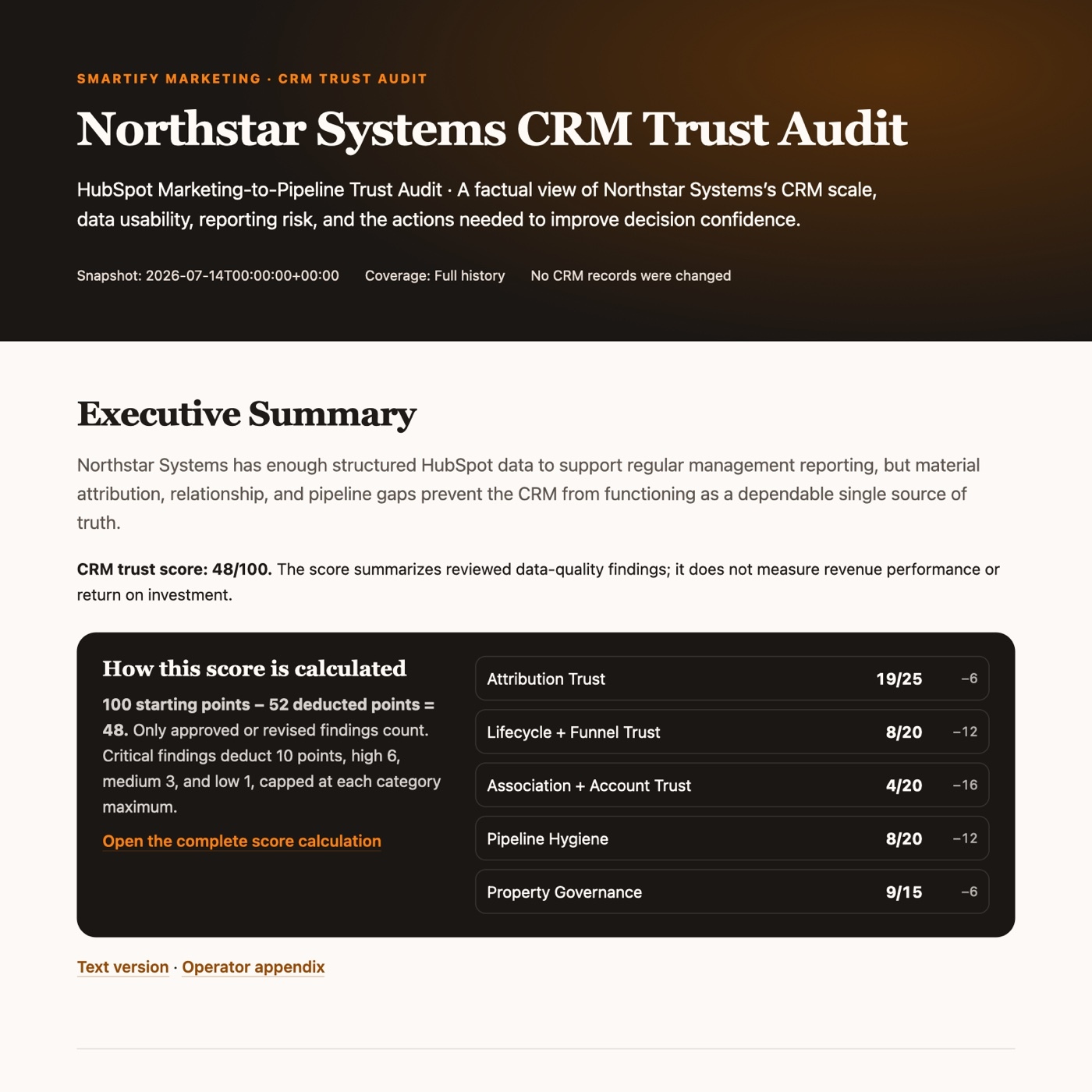
Tests whether reporting and attribution rest on reliable CRM evidence. It returns a CRM Trust Score, a clear boundary around what the business can trust, and an evidence-backed remediation plan.
FREE, OPEN-SOURCE AI AUDITS FOR HUBSPOT
Test CRM trust, uncover lifecycle leakage, and generate evidence-backed reports with prioritised repair plans—without changing a single HubSpot record.
Free and open source · Works with Codex, Claude Code & Gemini CLI · Runs locally · Read-only by design
MANUAL AUDIT VS AUDIT SKILLS
The skills do not replace an experienced operator. They replace hours of collecting counts, tracing associations, reconciling fields, and rebuilding the same evidence trail.
| Audit work | Manual HubSpot audit | B2B Growth Audit skills |
|---|---|---|
| Evidence gathering How the audit builds its evidence base. |
Open records, properties, and associations one by one. |
One repeatable, checkpointed evidence pass. |
| Time to first structured read How quickly the evidence becomes reviewable. |
Hours of collection before analysis can begin. |
Typically tens of minutes, depending on portal size and scope. |
| Consistency How repeatable the checks and calculations are. |
Depends on the auditor’s checklist and calculations. |
Validated stages, contracts, and scoring gates. |
| Traceability How findings remain connected to their source. |
Links and screenshots must be assembled manually. |
Findings stay tied to evidence and record context. |
| Human role Where experienced judgment is applied. |
Collect, calculate, reconcile, and judge. |
Validate context, challenge findings, and decide what to fix. |
| Safety boundary How CRM changes are controlled. |
Depends on process and permissions. |
Structurally read-only; no CRM write code. |
TWO AUDIT SKILLS
CRM Trust Audit tests whether HubSpot reporting rests on reliable evidence. Lifecycle Integrity Audit maps broken handoffs, exposed deals, and recoverable intent. Run either independently, or use both for a fuller diagnosis.
Tests whether reporting and attribution rest on reliable CRM evidence. It returns a CRM Trust Score, a clear boundary around what the business can trust, and an evidence-backed remediation plan.
Maps the selling journeys represented in HubSpot, then finds broken handoffs, ignored high intent, exposed active deals, and credible recovery opportunities.
WHAT ARRIVES
Each skill produces its own HTML and Markdown report, evidence files, score, final-gate result, and prioritised repair plan. Findings show what is affected, why it matters, who should decide, and what completion looks like.
Both skills keep a strict read-only boundary, but the reports remain confidential CRM artifacts and should be handled accordingly.
No. Both audits are structurally read-only. They do not write, merge, delete, reassign, change lifecycle stages, or enrol CRM records.
Each audit works independently, but we recommend running both for a complete view. Start with CRM Trust to establish the evidence boundary, then use Lifecycle Integrity to find journey-specific leakage.
Your source CRM data stays in your HubSpot portal. You run the audit locally with your own Codex, Claude Code, or Gemini CLI environment using read-only HubSpot access.
The audit creates snapshots and reports only in your local workspace. Smartify Marketing does not receive or store them, and they are never added to the open-source repository. Because these local files contain CRM evidence, treat them as confidential business artifacts.
Open the GitHub repository, choose the package-level quickstart, create the dedicated HubSpot Private App with the documented read scopes, and run the audit inside Codex, Claude Code, Gemini CLI, or another capable coding-agent environment.