
GTM strategy
Agencies, CMOs, and fractional leads answer one question differently: who owns the result? A guide for established B2B teams with no marketing owner.
When an established B2B company decides marketing finally needs to pull its weight, the question usually comes out as "Should we hire an agency, bring in a CMO, or find a senior partner?" Let me reframe it, because the way it is usually asked hides the real decision.
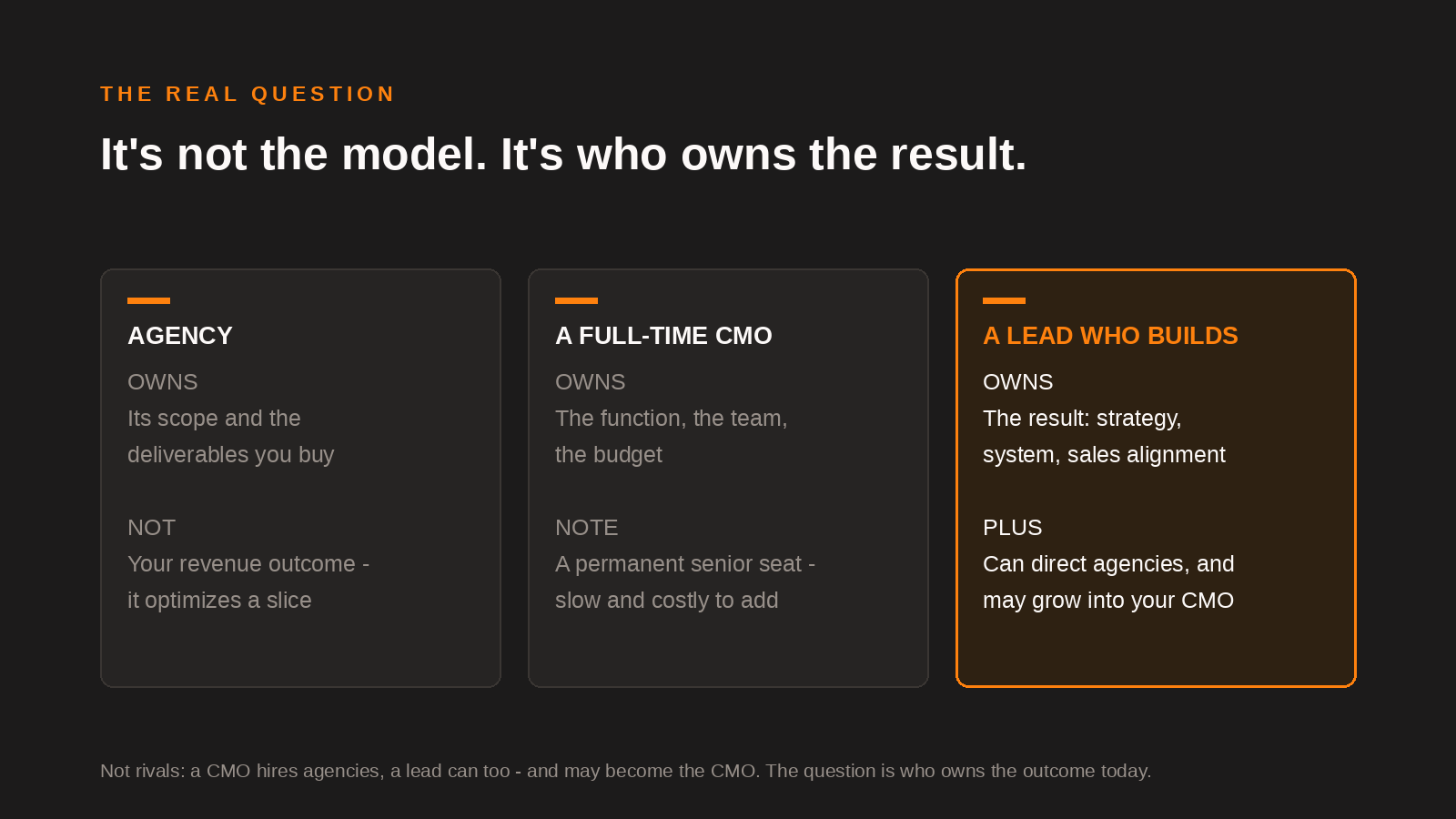
These three are not rivals on a shelf, and they are not a clean binary. In most mature companies they coexist: a CMO owns the function and hires agencies to execute under them. A fractional lead can hire agencies too. And a lead who stays long enough may eventually become the CMO.
So this is not "pick one of three competing vendors." The only reason to line them up is a specific situation I see constantly: an established B2B company that grew through sales and relationships and has no real marketing owner.
When no one owns marketing, the useful question is not "Which model is cheapest?" It is: Who is going to own the result?
First, Name The Real Problem
In almost every established B2B company I walk into, marketing is not missing. There is a website. There are campaigns. There are events. Often there is already an agency or in-house marketers who are taking requests from everyone.
What is missing is an owner: someone senior enough to be accountable for whether all that activity turns into revenue, and practical enough to connect strategy, systems, content, demand, and sales behavior.
The company grew through people, so marketing was bolted on rather than built. Each option answers the ownership question differently.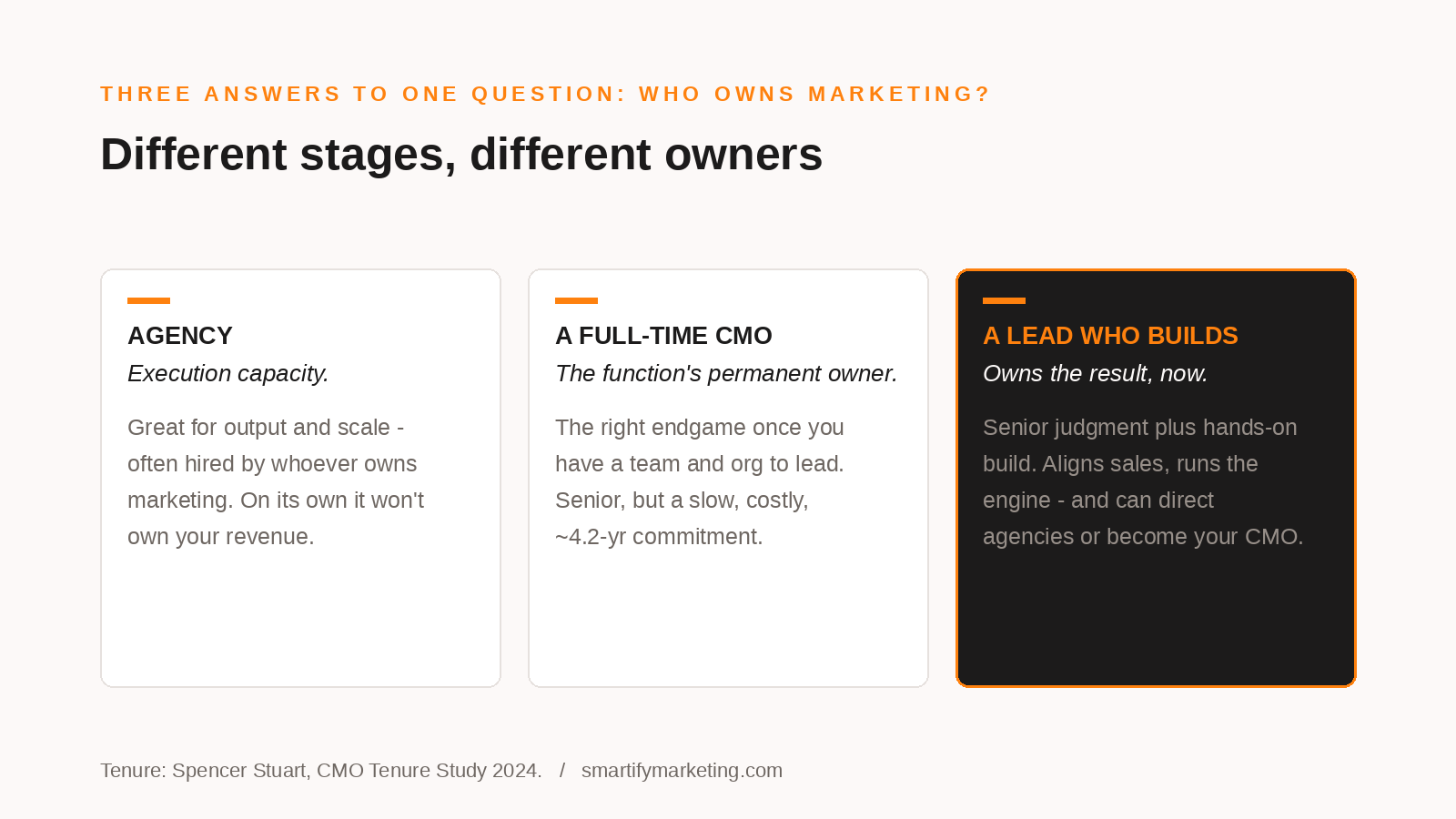
The Agency: Real Capacity, But Not An Owner
An agency is excellent when you already have someone owning marketing and need hands to execute. That is why agencies most often sit underneath an owner who directs them.
The trouble starts when a company with no owner hires an agency hoping it will become the owner. It will not, not because agencies are bad, but because of what the relationship is built to deliver.
An agency is accountable for producing its agreed scope. B2B agencies commonly run $5,000 to $25,000 per month, with broader full-service engagements running higher. That buys capacity, specialization, and delivery rhythm. It does not automatically buy senior ownership of your revenue outcome.
The Full-Time CMO: The Function's Permanent Owner
A CMO is the right person to own the marketing function once you have a function to own. The role is corporate by nature: leading people, owning budgets, managing stakeholders, sitting in cross-functional rooms, and making the marketing function work inside the company.
That is valuable. It is also mostly a management role. Many excellent CMOs have not written a positioning doc, rebuilt a lifecycle flow, or touched a CRM configuration in years. If you have a team and an organization that needs an executive to run it, that is the hire.
But as the first move, it is heavy. Current salary benchmarks vary: Built In lists average US CMO base salary at about $226,000, while Salary.com shows a higher CMO benchmark as of June 2026. Averi's 2026 cost analysis frames full-time CMO compensation at roughly $275,000 to $500,000 total comp, before recruiting time, onboarding, and the cost of waiting.
The search itself can be slow. Executive searches commonly average four to six months, and Spencer Stuart's 2024 CMO tenure study found Fortune 500 CMO tenure stabilizing at 4.2 years.
If you already have a function for a CMO to lead, that investment can make sense. If you do not yet have the function, it is a lot to commit before anything is built.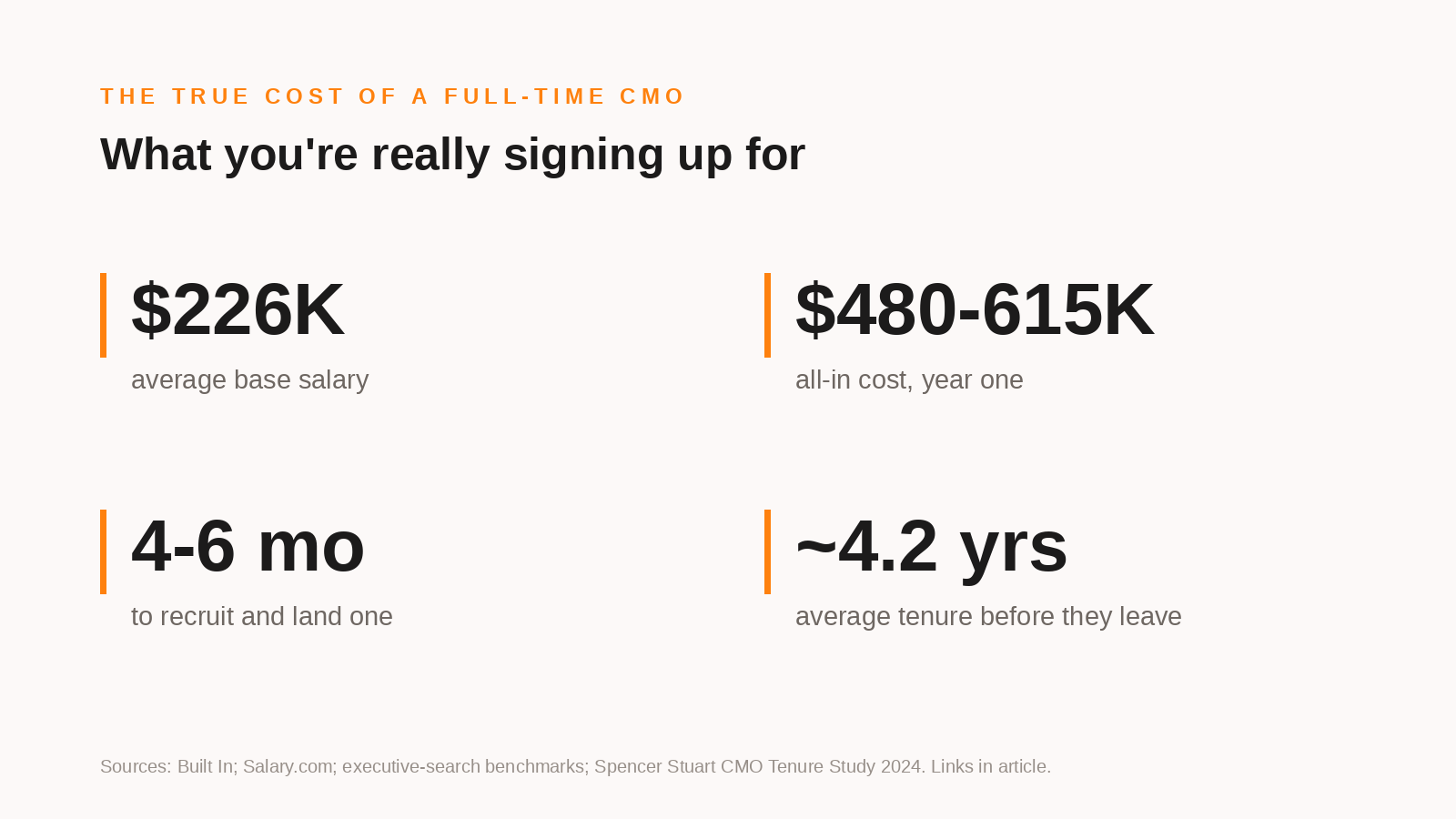
The Lead Who Builds: An Owner You Can Have Now
If your problem is that no one owns marketing, you need an owner. Possibly before you are ready for a permanent executive seat. Definitely faster than a months-long search allows.
A senior lead who builds is exactly that: someone who owns the result today. They decide what should happen and build enough of it to make progress real: positioning, messaging, campaigns, CRM, reporting, demand generation, and the marketing-and-sales alignment that gets the revenue engine running.
This matters because B2B buying is not linear. Gartner describes B2B buying as a set of buying jobs that buyers revisit, with multiple stakeholders and channels involved across the journey. When the buying process is that distributed, marketing cannot be a pile of disconnected tasks. One senior person has to connect the whole picture.
Averi's 2026 cost analysis puts fractional CMO support around $5,000 to $15,000 per month. That flexibility matters when Gartner's 2025 CMO Spend Survey found marketing budgets flat at 7.7% of company revenue.
So Which Fits You?
It depends on who already owns marketing, and these models can coexist and evolve.
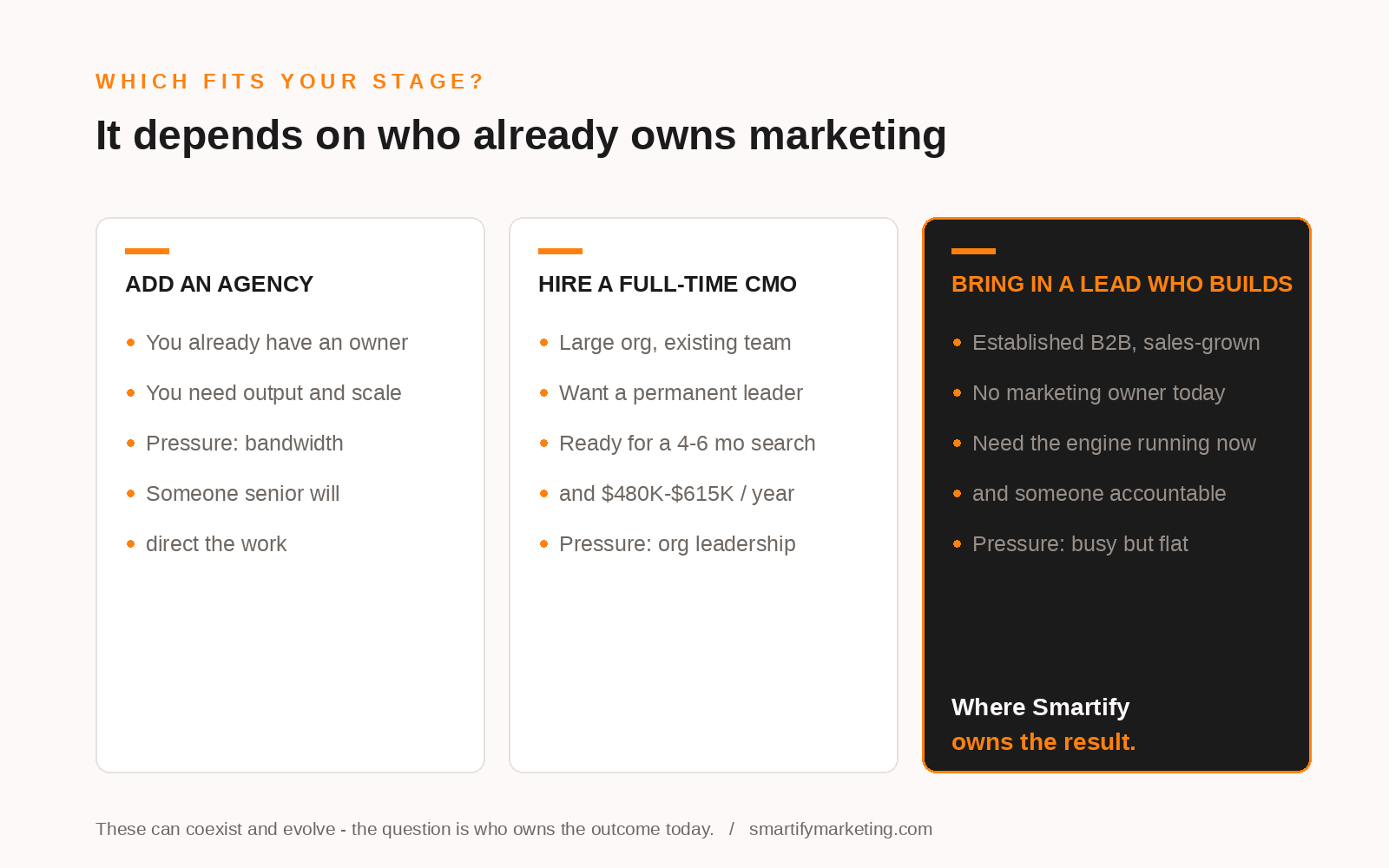
If you already have an owner and need execution, add an agency.
If you have a team, a budget, and an organization ready for executive marketing leadership, hire the CMO.
If you are an established B2B company that grew on sales, has plenty of marketing activity, but no one senior owns the revenue result, start with the lead who builds.
The tell is simple: if "we have lots of marketing activity but no one can tell me what it is doing for revenue" sounds familiar, you do not have an output problem. You have an ownership problem.
Start by deciding who owns the result.
_photo.jpg)