
Marketing Leadership
Why more marketing leaders are choosing fractional work: the hiring data, the supply side, how range and AI sharpen judgement, and what it really costs.
Fractional marketing leader is an awkward title. It sounds as if a CMO has been sliced into calendar blocks.
Behind the awkward title, though, sits a real change, and it runs in two directions. I see more founders considering a fractional marketing leader before they commit to a permanent executive hire. At the same time, I see more senior marketers choosing fractional work as a career.
Of the two, the second movement interests me more. Why would an experienced marketing leader give up one seat, one salary and one set of colleagues to work across several companies?
My answer has two parts. First, marketing rewards range, because it runs on attention and fresh input. Second, in the AI era a knowledge worker sells impact, and impact does not grow in a straight line with hours. Put together, those two forces make fractional work one of the fastest ways I know to build judgement. I have worked this way for two years through Smartify Marketing, and I have grown more in those two years than in the ten before them.
Before I get to the marketer's side, though, it is worth seeing how quickly the company side has moved.
Companies are buying senior leadership more flexibly
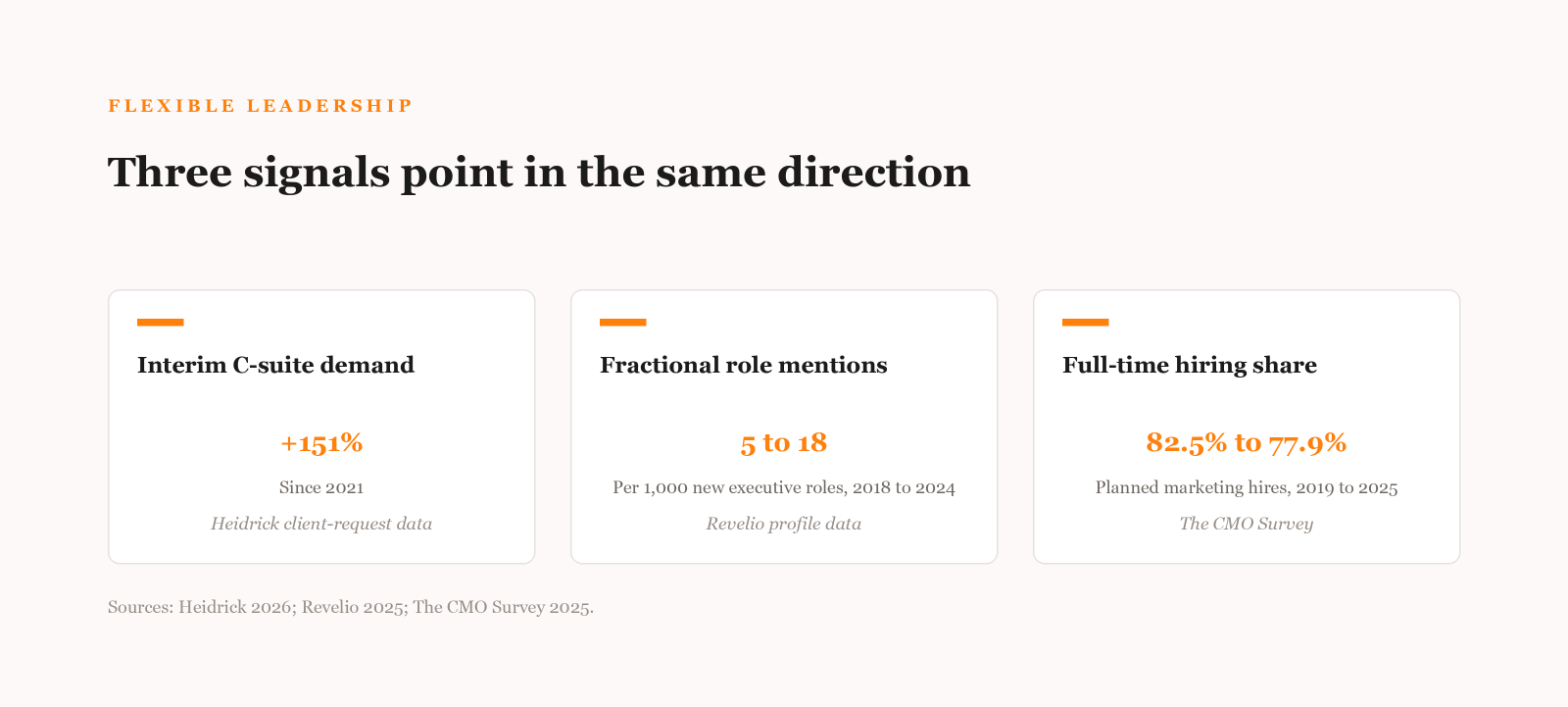
Heidrick & Struggles' 2026 High-End Independent Talent Report found that demand for interim C-suite leaders in North America and Europe has risen 151% since 2021. Marketing is part of that shift: requests for interim CMOs doubled in a single year, and requests for interim marketing and sales leaders rose 33%.
Hiring plans show the same shift. According to The CMO Survey's 2025 report, companies now expect 77.9% of their planned marketing hires to be full-time employees, down from 82.5% in 2019. Every flexible arrangement, from full-time contractors to part-time employees, took the share that full-time roles gave up.
The executive titles people use are changing too. Revelio Labs found that mentions of fractional roles rose from 5 to 18 per 1,000 new executive positions between 2018 and 2024.
Marketers are moving even faster
If demand is rising, supply is rising faster, and marketing sits near the front of it. The first State of Fractional report from FRAK, the Fractional Conference, counted more than 140,000 professionals on LinkedIn with "fractional" in their titles in 2024, with marketing and technology leading. In Revelio's data, CMO is already the second most common fractional role, at 14.3%, just behind CFO at 18.8%.
The wider independent workforce is growing in the same direction. MBO Partners' State of Independence 2025 counts 5.6 million US independents earning more than $100,000 a year, up from 1.9 million in 2011, and 63% of independents say they work this way fully by choice.
In fact, supply may already be outrunning demand. Axios reported that one job board, Fractional Jobs, attracted nearly 11,000 fractional workers in under a year, against 85 hiring companies. Experienced leaders are choosing this path faster than the market is creating seats for them.
So why are they choosing it anyway? I can't speak for every fractional worker, but for the marketing profession specifically, I think the answer lies in the nature of marketing itself.
Marketing rewards range
Marketing keeps changing underneath the people doing it. Platforms change distribution, competitors copy a message that works, a cheap channel becomes expensive and buyers change how they research. A discipline like that runs on a steady intake of new information, new inspiration and new attempts.
Much of marketing also starts with attention: knowing what makes a particular audience stop, care and act. That feel does not come with age. It comes from seeing more, trying more and feeling more.
For that reason, I believe a marketer who has worked with two companies over the past year can have more good ideas than one who has spent many years in the same company. Each company gives the other a point of contrast, and in marketing that contrast is where many ideas come from.
The mechanism is a loop. You make a decision, watch reality disagree, adjust the method and carry the corrected pattern into the next situation. Fractional work runs that loop in several places at once, so each lesson gets its next test within weeks instead of years. If a campaign stalls at one client because the message speaks to users while the budget sits with finance, the next brief at another client starts with the buying committee before anyone touches the ad copy. If a new pricing page lifts demo requests in one company, the same test can run in another soon after, and the second result shows whether the first was a principle or a lucky context. Each round turns a single data point into a pattern the leader can decide from.

Of course, range can also build up inside one employer, through a move from demand generation to product marketing, a launch in a new country or a channel rebuilt after its economics change. What matters, however, is how often a lesson gets tested in a new context, and in a single seat that test comes around far less often.
Other fractional leaders describe the same acceleration. Wade Anderson wrote that he gets "to sit inside multiple different businesses at once, watch their decision rhythms, see what systems hold up under stress, and test my frameworks across them all." His conclusion: "The learning compounds faster than anything I have done before." Aimee Schuster put the contrast more bluntly: after the first year of building, full-time work "becomes more rinse and repeat".
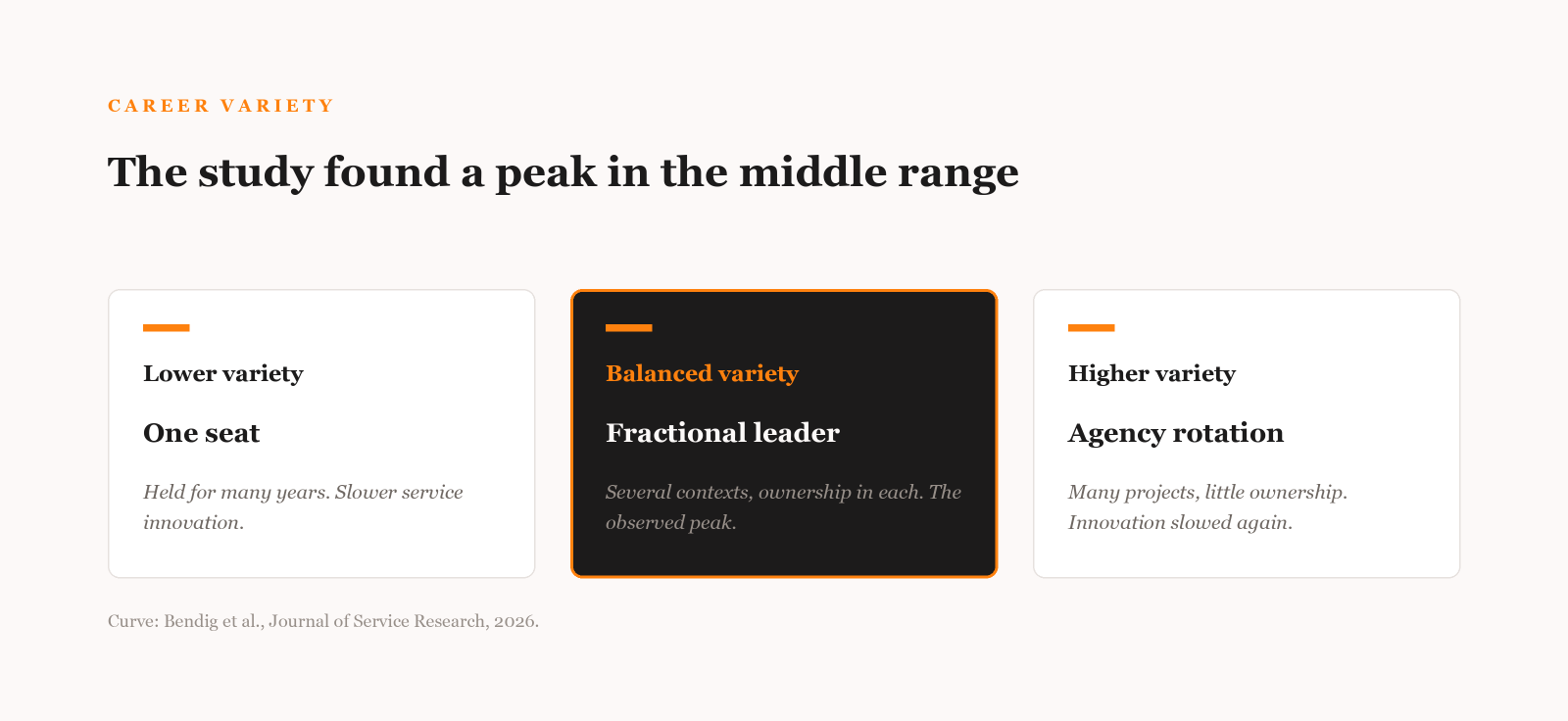
To be clear, I am not saying that more variety is automatically better. Research on CMO careers shows where the sweet spot sits. A 2026 Journal of Service Research study, Specialist, Generalist, or Both?, followed 209 S&P 500 companies. Companies whose CMOs had a moderate mix of career experience innovated fastest in services. Companies whose CMOs had the least variety moved more slowly, and so did those whose CMOs had the most.
I read that curve through the three ways companies usually buy marketing work. At the low end is one seat held for many years. At the high end is agency rotation: many projects, constant movement, but little ownership and little time for anything to settle. In the middle sits the fractional leader, who works across several contexts and still owns the result in each. That ownership difference is the same one I set out in Agency, a CMO Hire, or a Lead Who Builds?
In the AI era, leaders sell impact
Range explains why fractional work teaches so much. AI explains why it is now possible to do it well.
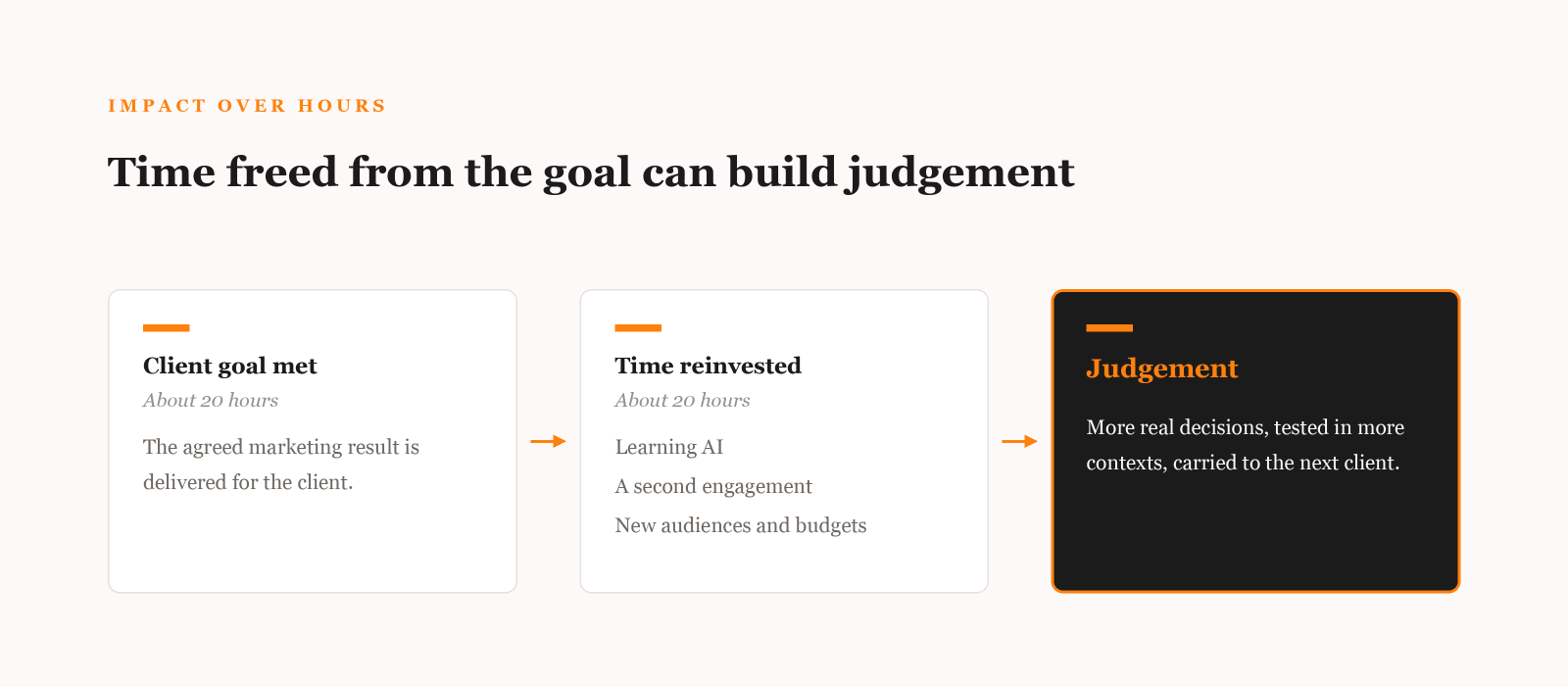
In the AI era, what a knowledge worker sells is impact, and impact is not linear in hours. If 20 hours achieve the result, there is no reason to sit for 40. A salaried leader who finishes early rarely gets those hours back, because the organisation absorbs them. A fractional leader is hired for the result, so the hours the result no longer needs are theirs to reinvest.
Take a simple example. A fractional marketing leader meets a client's marketing goal in 20 hours a week. The other 20 can go to learning AI, taking an outside consulting engagement, or testing campaigns with new audiences and budget levels. Each of those sharpens judgement, and over the years that is what keeps a leader competitive.
As AI models get more powerful and execution gets more efficient, direction becomes more valuable. When AI can produce more research, content and analysis than anyone can review, the scarce skill is deciding which work matters, and that skill grows with the number of real decisions a person has made. Which brings the argument back to range.
What two years of fractional work did for me
Over the past two years, I have grown faster than at any other point in my career, in technology, in strategy and in leadership.
Of course, a large part of that is timing. Frontier AI models have improved dramatically over those two years, and they freed up my working capacity: on my own, I can now handle work that used to need a team. I described how that works in practice in How I Lead a High-Autonomy AI Marketing Team.
Still, I believe the fractional practice itself played a big role. I work with several companies and their teams, try a range of AI solutions, get challenged by people who see problems differently, and deploy my solutions onto whatever tech stack each client runs. Solving those real problems pushed me further than any single role had.
My week reflects that. A client engagement can take anywhere from 4 to 40 hours a week. Whatever the client work takes, I spend at least another 20 hours every week learning what the newest models and agents can do, and because I am fractional, I can put my own time and money into the most advanced tools without waiting for a company policy to allow it.
What drives those 20 hours is a kind of insecurity. Technology is moving, and a Chinese saying puts it well: learning is like rowing upstream; stop rowing and you drift back (学如逆水行舟,不进则退). I think this is a healthy insecurity. People in corporate roles feel it too, but there the answer is often to learn corporate survival and managing up, and the hours go there instead of into abilities that actually grow. I am glad that, at the moment technology is moving fastest, I have the freedom to invest in myself in the right place.
What it costs
Healthy or not, insecurity is uncomfortable, and leaving the comfort zone is the first price of fractional work.
The second is income. When an engagement can range from 4 to 40 hours a week, income moves with it, and finding the next client never stops. Other fractional leaders say the same. Schuster wrote that "success has come in waves", and the fractional CMOs interviewed by exchange4media named income uncertainty, constant business development and context switching as the core challenges.
The third is working without a team around me. A team of one plus AI agents gets a lot done, but nobody sits at the next desk. Marissa Brassfield calls isolation the cost nobody budgets for, and she cites a 2024 Leapers survey in which 90% of 715 freelancers had experienced isolation or loneliness.
Finally, range has a ceiling. Spread across too many companies, a leader gets shallow context in each, and patterns stop transferring. This is the upper end of the curve above. Amanda Rabideau, a fractional CMO, told Mixing Board that she takes no more than three fractional clients at a time: "if I'm at capacity, I'm at capacity."
Even so, I love this way of working. And I believe that staying fractional, and staying hungry to learn, is also the best thing I can do for the companies I work with.
Why this is good for companies too
That is because what a fractional leader builds for themselves is exactly what the client buys: range, current AI practice and judgement tested in several places. A company gets a leader who has recently seen what works, and what fails, in other companies, without rebuilding its team around a permanent executive.
To get that value, the company only has to give the leader real decision rights over priorities, budget and direction. With them, the fractional leader owns the result. Without them, even the best advice becomes one more voice in the meeting.
Two sides moving toward each other
Companies are learning to buy senior marketing leadership in more flexible shapes. Marketing leaders, in turn, are learning that a portfolio can teach them faster than a single seat.
Of the two, I still think the second change matters more. Marketing runs on attention and fresh input, and AI has loosened the link between hours and impact. A leader who works across companies, uses the spare capacity to learn and keeps testing lessons in new contexts makes better decisions. That is the leader I want to be, and I think it is the leader more companies will want to hire.
_photo.jpg)