
Digital Marketing
LinkedIn is the default B2B channel, but it should not decide your plan. Map where buyers discover and trust suppliers, and keep the channels that bring sales.
Ask a B2B marketer where their buyers are, and the answer often arrives before the question ends: LinkedIn. It has become the standard answer for B2B, and budgets follow it. In Dreamdata's 2026 LinkedIn Ads B2B Benchmarks, LinkedIn takes 41% of B2B paid social budgets.
The standard answer is getting harder to rely on, though. A LinkedIn click costs B2B advertisers €5.98 on average in Dreamdata's data, against €1.60 on Meta. Organic reach keeps shrinking too: company page posts now reach about 1.6% of their followers, according to the Algorithm InSights 2025 Report, which analysed 1.8 million posts. No wonder so many teams are looking for better channels.
My own doubts about the standard answer started somewhere I did not expect. After I started my own company, I began talking to businesses far outside the SaaS world I knew. Many of those conversations never turned into projects, but almost every one taught me how buyers in that industry actually find suppliers. Traditional manufacturing taught me the most.
I once built a TikTok strategy for a manufacturing factory. Yes, you read that right: TikTok. Most people assume B2B buyers are not on TikTok, and working with this client showed me how presumptuous that assumption was. The account had only a few hundred followers, yet it brought the factory real leads and new customers.
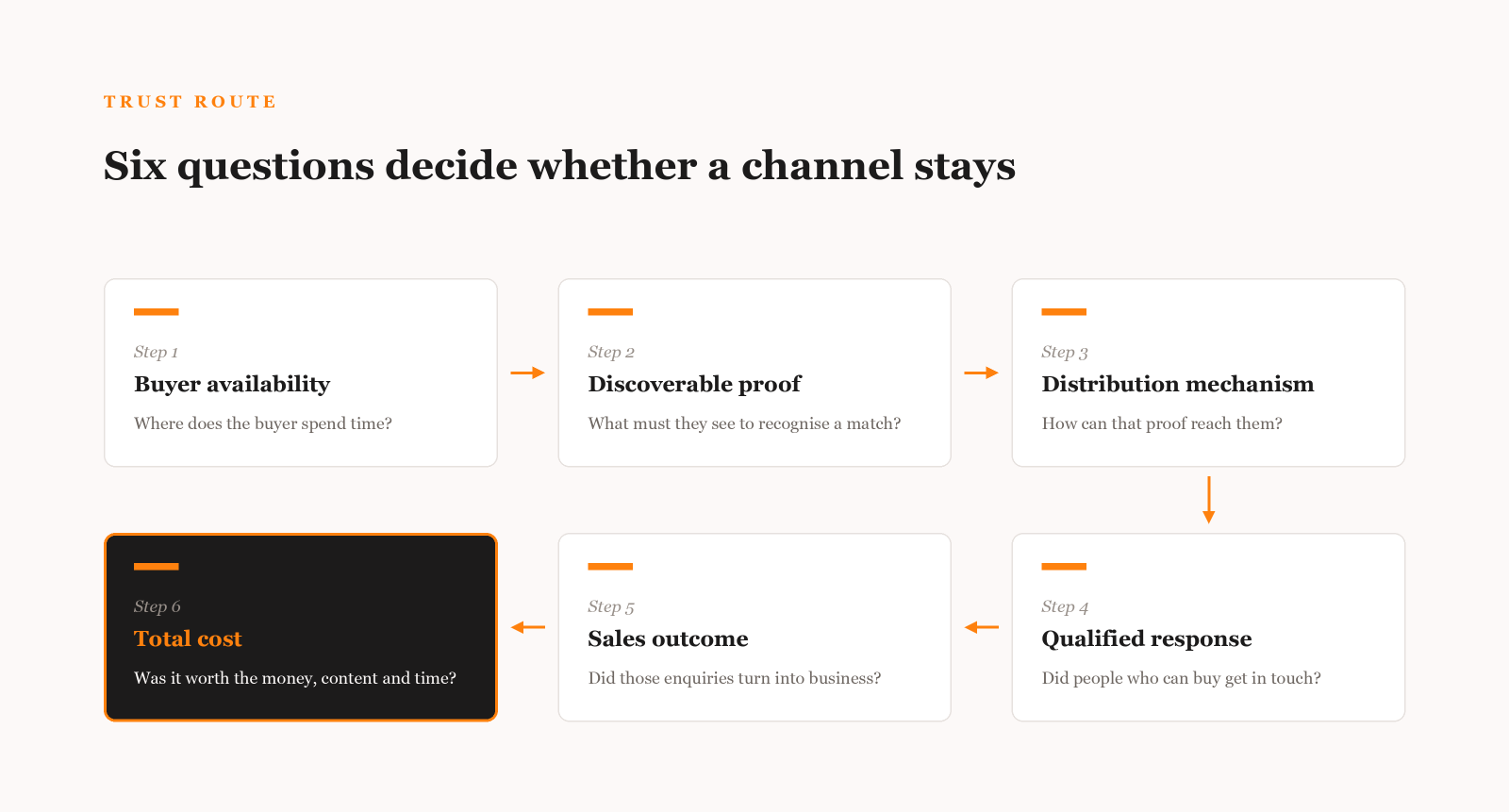
TikTok is only the example here. The lesson applies to every channel: a channel should not be chosen by assumption. LinkedIn still deserves investment wherever it brings business, but it should not be the automatic answer. What should decide a channel is the trust route, the path through which a buyer discovers a supplier and comes to trust it, and whether that route ends in sales at a cost you can defend. I now work through that route in six steps.
Start with where the buyer actually is
The first step sounds obvious, yet it is the one most often skipped, because "B2B" feels like an answer. In reality, B2B describes a commercial relationship. It says nothing about where the buyer spends the day.
In many B2B industries, the customer is itself a small business: a workshop owner, a local distributor, a family-run manufacturer. Few of these people are active on LinkedIn or other "professional" platforms, and many rarely use Google or AI search to look for suppliers. Almost all of them, however, use social media, and they spend far more time there than in search.
The wider data points the same way. DataReportal counts 5.66 billion social media user identities, and more than two in three people on Earth now use social media. On average, users spend 18 hours and 36 minutes a week on social platforms. Social media is also closing in on search as a place where people discover brands: 29.7% of internet users find new brands through social media ads, close to the 32.8% who find them through search engines, according to GWI data reported by DataReportal.
So the first question in a channel plan is who signs off on the purchase and where that person spends time. Only after that does the platform question make sense.
Decide what proof the buyer needs to find
Knowing where the buyer is only helps if you also know what they need to see when they get there. That, in turn, depends on what makes their search hard.
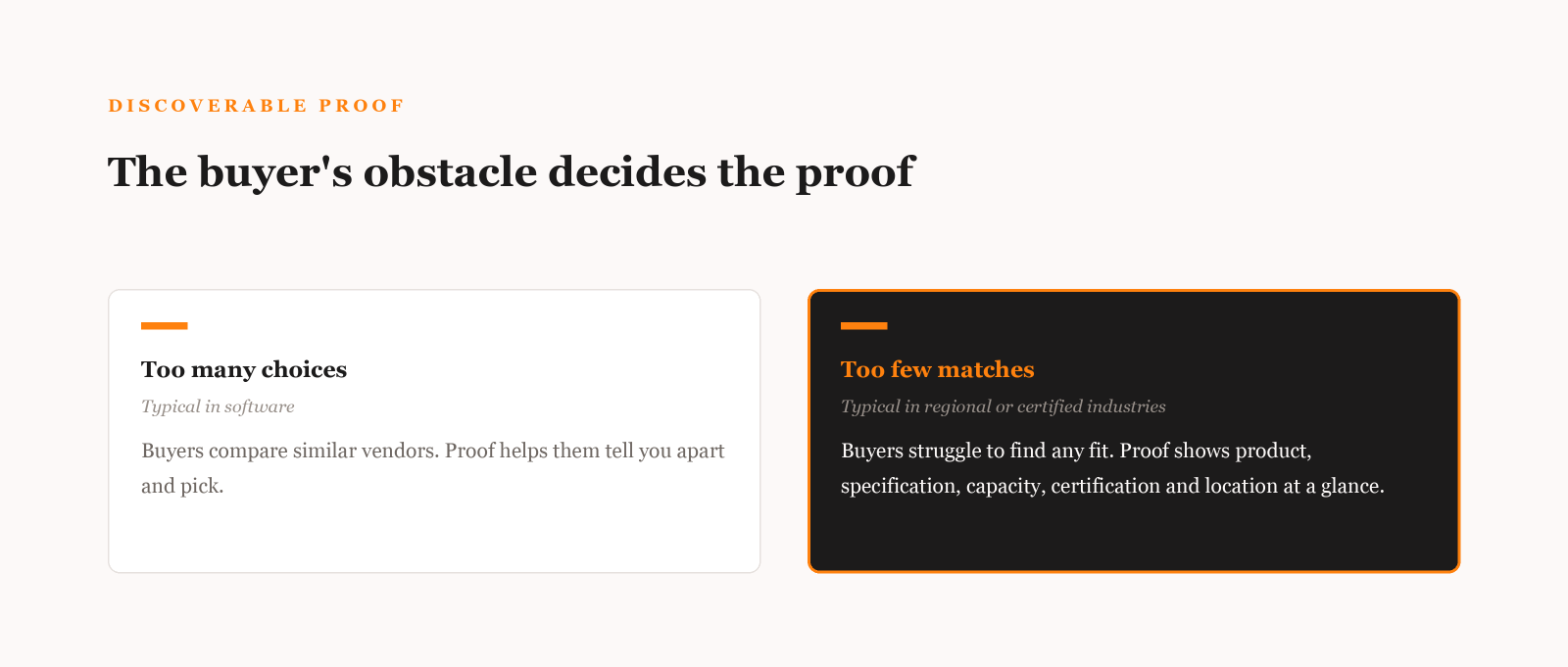
In software, the obstacle is usually choice. Buyers face dozens of similar vendors, so marketing has to help them compare and pick. Many traditional industries work differently. Their markets are often regional or protected by certifications and entry requirements, so there are fewer suppliers to begin with. The buyer's biggest problem is finding a supplier that fits the need at all: the right product, specification, capacity, certification or location.
In markets like that, marketing becomes matchmaking. The proof that matters is concrete: what a supplier can make, to what standard and for whom, shown plainly enough that the right buyer recognises the match the moment they see it.
That is why I define the proof before choosing the channel. A channel that cannot carry that proof to the buyer is the wrong channel, however professional it looks.
Match the proof to the distribution mechanism
Once the proof is clear, the next question is how it can reach the buyer. Each channel moves content through a different mechanism. Search depends on the buyer already looking. Referrals and associations depend on relationships. Events depend on people being in the same room. Algorithmic feeds depend on interest signals.
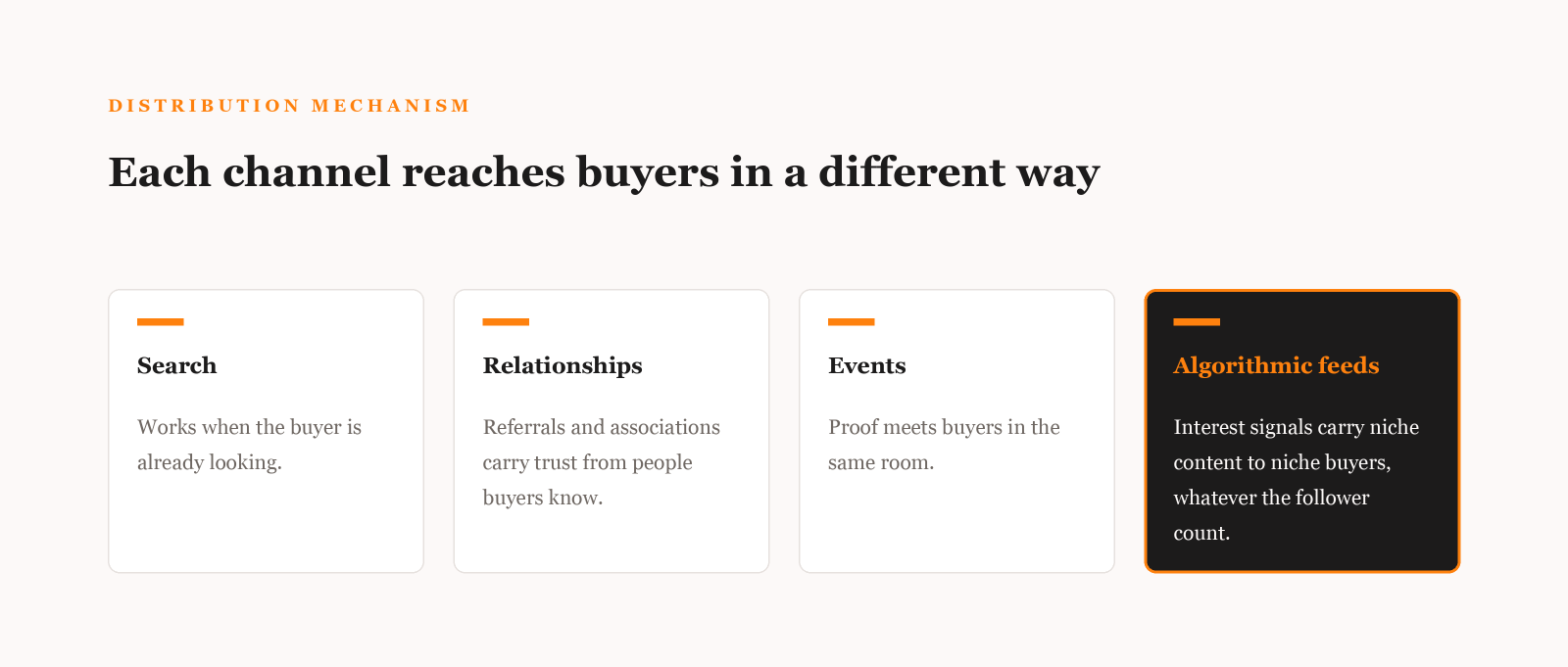
That last mechanism explains what happened with the factory. TikTok says its recommendations are driven by how people interact with content, with interaction signals such as watch time generally carrying more weight. Few people open TikTok to look for suppliers. Once someone watches a video related to their work, however, the feed keeps showing them more of the same. The more niche and long-tail the topic, the more precisely the algorithm can deliver it to the small group of people who care about it. That is how an account with a few hundred followers kept reaching the right buyers.
It also means follower count is the wrong measure for an algorithmic channel. Followers describe who subscribed, while the algorithm decides who sees the content. What matters is whether the right people see the proof and respond to it.
Keep or cut every channel by the same three measures
Reaching the right people, however, is only half of the route. For a channel to earn its budget, the route has to continue all the way to revenue, and three measures show whether it does.
The first is qualified response: enquiries, quote requests or introductions from people who could actually buy. The second is sales outcome: how many of those responses sales accepted, and how many became opportunities, orders or repeat business. The third is total cost: media spend plus content production, people's time and the months a channel needs to mature.
Applied to every channel in the plan, these measures turn into a short set of questions:
- Does this channel reach the people who sign off on the purchase?
- Did it produce qualified enquiries in the last period?
- How many of those enquiries turned into business?
- What did the channel cost in total, including time?
- Would we still fund it if it had no reputation as "the B2B channel"?
Under this test, a TikTok account with a few hundred followers can earn its budget, and so can a LinkedIn programme. Each simply has to prove it. And if any channel, LinkedIn or otherwise, is expensive and brings in no real customers, it should come off the channel plan.
B2B is still people buying from people
In the end, B2B is business between people, and the job of a channel plan is to reach the person who pays, wherever that person actually spends time. If TikTok brings in business, why not use it? And if a channel looks right for B2B but brings in nothing, why keep paying for it?
So before the next budget cycle, it is worth asking the question the factory taught me: where does our buyer actually discover and come to trust a supplier, and has our budget followed them there?
_photo.jpg)